
What Makes Some Dents Easy to Repair and Others More Difficult?
Two dents can look almost identical at first glance, yet one may be repaired fairly quickly while the other requires significantly more work.
Why?
Because dent repair is not determined by size alone.
The location of the dent, depth of the impact, condition of the paint, type of metal, and accessibility behind the damaged panel can all influence how complicated the repair becomes.
At JJ Autobody Inc., every dent is evaluated individually because the right repair method depends on what actually happened to the panel, not simply how large the dent appears.
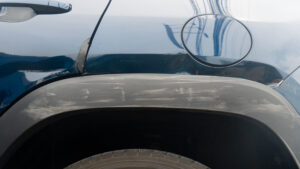
A Small Dent Isn’t Always a Simple Dent
It is easy to assume that a smaller dent automatically means an easier repair.
That is not always true.
A small but deep dent located along a sharp body line can be more challenging than a larger, shallow dent in the middle of a flat door panel.
Think of it this way:
A dent is not just a low spot in the metal. The impact stretches, bends, or pushes the panel away from its original shape. The more complicated that movement becomes, the more precision may be required to restore it.
Here are some of the biggest factors that can make a difference.
-
Where the Dent Is Located
Location can dramatically change the difficulty of dent repair.
Dents located in open areas of a door, hood, or quarter panel may provide technicians with better access and more room to work.
Damage near the following areas can be more complicated:
- Panel edges
- Wheel arches
- Door seams
- Sharp body lines
- Reinforcement sections
- Areas near handles or trim
- Corners of bumpers or fenders
These areas often have stronger curves or additional structural support behind them.
A dent across a body line, for example, does not only need to be pushed outward. The original contour of the vehicle also needs to be recreated accurately.
-
How Deep the Metal Was Pushed
Imagine pressing lightly into a sheet of aluminum foil.
A gentle push creates a broad indentation.
Now press one small area very hard.
The second mark becomes sharper and more concentrated.
Automotive panels can behave in a similar way.
A broad, shallow dent may leave the metal relatively close to its original shape. A deep impact can stretch the panel and create high spots, creases, or tension around the damaged area.
Once the metal becomes heavily stretched, simply pushing the dent outward may not completely restore the original surface.
This is one reason technicians need to examine the shape of the entire damaged area instead of concentrating only on the deepest point.
-
Whether the Paint Is Still Intact
The condition of the paint often determines which repair options are available.
When a dent occurs without cracking, chipping, or severely damaging the factory finish, paintless dent repair (PDR) may sometimes be an option.
PDR involves carefully reshaping the panel without performing traditional body filler and repainting.
However, if the collision has:
- Cracked the paint
- Exposed bare metal
- Created deep scratches
- Chipped the finish
- Damaged multiple layers of paint
additional body and paint work may be necessary.
This means two dents of the same size can require completely different repair processes simply because one damaged the paint and the other did not.
-
What’s Behind the Dent Matters Too
Technicians do not always have easy access to the backside of a damaged panel.
Doors, quarter panels, hoods, and other areas may contain:
- Reinforcement bars
- Wiring
- Window mechanisms
- Brackets
- Sound insulation
- Structural components
When the backside of the dent is accessible, certain repair techniques may be easier to perform.
When another component blocks access, technicians may need to remove trim or use a different repair approach.
So while you might only see one dent from outside the vehicle, what is located behind the metal can influence the entire repair.
-
Creases Change the Repair
Round dents and creased dents behave differently.
A rounded dent usually spreads the impact across a wider portion of the panel.
A crease concentrates the damage along a narrow line.
Creases can create stronger tension in the metal, especially when they run through a vehicle’s natural body line.
The sharper and deeper the crease becomes, the more carefully the panel needs to be reshaped.
Long dents caused by shopping carts, parking-lot impacts, or another vehicle’s door can sometimes create these types of concentrated lines.
-
The Type of Panel Can Make a Difference
Not every vehicle uses the exact same materials.
Depending on the vehicle, body panels may be made from different grades of steel, aluminum, or other materials.
Each material responds differently when damaged.
Some panels may flex and return closer to their original shape, while others may stretch more easily or require specialized techniques during repair.
Even panel thickness and design can affect how technicians approach the damage.
This is why dent repair should not be treated as a one-method-fits-all service.
When Is Paintless Dent Repair Possible?
Paintless dent repair can be an excellent option for certain dents because it focuses on restoring the panel while preserving the existing paint.
However, whether PDR is appropriate depends on several factors.
A dent may be a better candidate when:
- The paint remains undamaged
- The metal has not been severely stretched
- The dent is accessible
- The damage is relatively shallow
- The panel has not suffered major structural damage
If those conditions are not present, traditional dent repair may provide the better result.
The goal should always be choosing the repair process that properly addresses the damage rather than forcing every dent into the same repair method.
Let the Dent Tell the Story
Instead of asking only, “How big is the dent?”, a better question is:
“What happened to the metal when the dent occurred?”
That tells technicians much more.
A wide shallow depression on a door may be fairly straightforward.
A smaller dent located on a wheel arch with damaged paint and a sharp crease may require significantly more attention.
The appearance from several feet away rarely tells the entire story.
Dent Repair at JJ Autobody Inc.
We evaluate the dent itself, the surrounding panel, the paint condition, and the location of the damage before determining the appropriate repair approach.
Whether your vehicle has a small parking lot ding, a deep crease, or dent damage caused by a collision, proper evaluation can help determine the best way to restore the affected area.
A dent may look simple from the outside, but the details underneath are what determine the repair.
Have a dent you’re unsure can be repaired? Contact JJ Autobody Inc. and let our team take a closer look.